
The Asia-Pacific (APAC) region is often described as a mosaic of cultures, economies, and regulatory frameworks. With over 50 countries, thousands of languages, and diverse political systems, it’s easy to see why businesses traditionally approach the region market by market. Yet, in today’s interconnected economy, viewing APAC as one unified market is not just a bold idea—it’s a strategic imperative.
The Scale and Economic Power of APAC
APAC is home to more than 4.3 billion people, representing nearly 60% of the global population, and is projected to contribute 60% of global economic growth in the coming years. This sheer scale offers businesses unparalleled opportunities for expansion. Treating APAC as a single market allows companies to leverage this collective demand, rather than fragmenting strategies across individual countries.
The region’s economic dynamism is evident in its rapid urbanization, rising middle class, and digital transformation. Southeast Asia’s digital economy alone is projected to grow from $300 billion in 2024 to $1 trillion by 2030, driven by mobile-first consumers and tech-enabled ecosystems. For global businesses, this means APAC is not just a growth engine—it’s the engine.
Regional Integration: Trade Agreements as Catalysts
The rise of trade agreements like RCEP (Regional Comprehensive Economic Partnership) and CPTPP (Comprehensive and Progressive Agreement for Trans-Pacific Partnership) has transformed APAC into a more integrated economic zone. RCEP alone connects 15 countries, creating the world’s largest free trade bloc and reducing tariffs on over 90% of goods traded within the region. These agreements simplify cross-border operations, harmonize rules of origin, and streamline customs processes—making regional strategies more practical and cost-effective.
By consolidating fragmented trade frameworks, these agreements enable businesses to operate with greater predictability and efficiency. For companies seeking scale, this integration is a game-changer.
Supply Chain Resilience and Operational Efficiency
Global disruptions—from geopolitical tensions to pandemic shocks—have accelerated the need for resilient supply chains. Businesses are increasingly adopting regionalized models such as “China Plus One,” diversifying production across APAC to mitigate risk. Countries like Vietnam, Indonesia, and Thailand are emerging as attractive alternatives for manufacturing and logistics hubs, supported by foreign investment and infrastructure upgrades.
Managing operations regionally allows companies to reduce costs, strengthen oversight, and ensure continuity in a volatile global environment. High-performing supply chains in APAC have been shown to directly correlate with revenue growth, underscoring the strategic importance of regional integration.
Digital Synergies and Innovation Hubs
APAC is a leader in digital adoption, mobile-first economies, and e-commerce growth. Countries like China, South Korea, and Singapore are innovation powerhouses in AI, fintech, and cloud services. Viewing APAC as one market enables businesses to tap into these ecosystems collectively, accelerating digital transformation and creating unified customer experiences.
The region’s super-app culture—from WeChat in China to Grab in Southeast Asia—illustrates the potential for integrated digital strategies. These platforms offer access to millions of consumers across multiple markets, making regional approaches more efficient and impactful.
Case Studies: Success Through Regional Thinking
Companies that have embraced a unified APAC strategy have seen transformative results. For example, global tech firms have scaled their cloud businesses across seven APAC markets by creating unified go-to-market motions and leveraging regional partnerships. This approach has delivered double-digit ARR growth and established market leadership positions.
Similarly, consumer brands that localized digital campaigns while maintaining regional consistency have achieved significant penetration in diverse markets—from Japan’s subtle messaging norms to China’s influencer-driven ecosystems.
Challenges: Diversity Still Matters
While the benefits are clear, APAC is not homogenous. Cultural, regulatory, and linguistic differences remain significant. Successful regional strategies require localization within a unified framework, balancing scale with sensitivity. Businesses must invest in market research, build local partnerships, and adapt offerings to meet country-specific needs.
The Future: APAC as the Growth Engine
By 2030, APAC will account for nearly half of global renewable energy investment and dominate global consumption growth. Its young labor markets, advanced tech centers, and hyperconnected megacities position it as the epicenter of innovation and economic expansion.
For businesses, the question is no longer whether to view APAC as one market—but how quickly they can adapt to this reality. Those that succeed will unlock economies of scale, operational efficiencies, and innovation synergies that redefine global competitiveness.
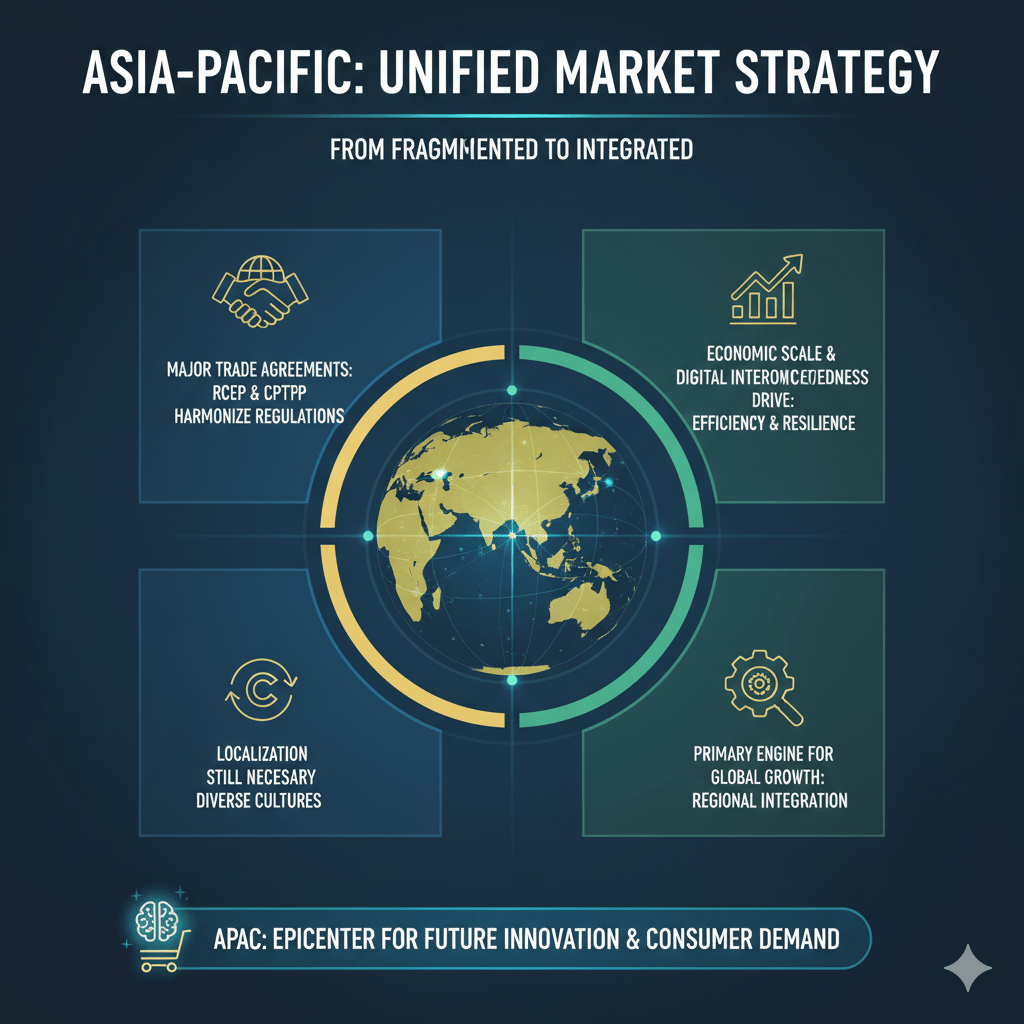
Key Takeaways
- Scale matters: APAC’s population and economic growth make it the ultimate frontier for global businesses.
- Integration is accelerating: Trade agreements like RCEP and CPTPP simplify cross-border operations.
- Digital-first strategies win: Unified approaches to e-commerce and fintech drive regional success.
- Resilience is non-negotiable: Regionalized supply chains mitigate risk and enhance agility.
- Localization within unity: Cultural and regulatory nuances require tailored execution under a cohesive strategy.
Bottom Line: Viewing APAC as one market is not just a strategic choice—it’s a growth imperative. In a world where complexity often breeds caution, APAC offers a rare opportunity: transform complexity into competitive advantage.

