

Have you ever wondered why so many Western direct-selling companies fail in Korea? A closer look at the Korean market reveals far more failures than success stories among these global companies.
After spending time in Korea and Vietnam, and meeting leaders from other APAC countries, I’ve realized that cultural friction – combined with a digital-native generation – is forcing American and European MLM giants to make a choice: adapt or exit.
The End of the Old Playbook
For decades, Western MLMs exported a version of the “American Dream” to Asia: a dream of individual wealth, flashy luxury, and relentless hustle. But as we move through 2026, that dream is hitting a cultural and generational wall. In markets like South Korea, Vietnam, Indonesia, and China, the old playbook—built on high-pressure sales and physical networking—is failing.
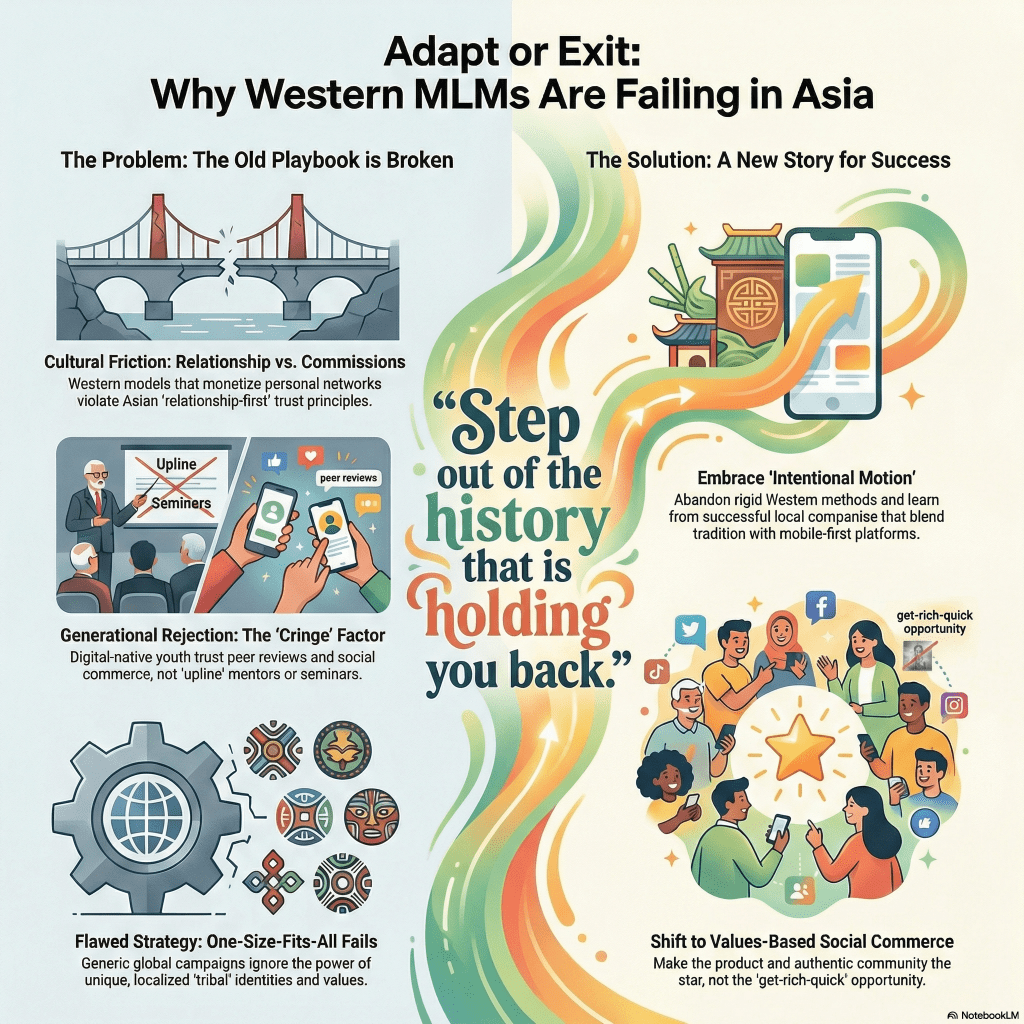
This isn’t just a market slump; it’s a generational refusal to live in a history that no longer fits their reality. As Oprah Winfrey said, “Step out of the history that is holding you back.” For Western MLMs, the history of transactional relationships is holding them back, while a new story of authentic, digital-first community is waiting to be written.
1. Cultural Friction: Relationship vs. Commissions
Western models often treat social networks as “leads.” In many Asian cultures, this violates the principle of relationship-first trust (Guanxi in China, social capital in Korea). When a distributor profits directly from family and friends, it can cause a “loss of face.” In the East, business is built on relationships first; in the West, relationships are often used merely to build business.
Regulators and communities are increasingly protecting social harmony from predatory “get-rich-quick” schemes. The result? A sharp decline in MLM participation.
2. The Generational Shift: The Death of the “Upline”
The generation gap in Asia is a technology chasm. Gen Z and Millennials are digital natives who don’t want hotel ballroom seminars or “Diamond Level” mentors. They trust peer reviews, TikTok Shop influencers, and Shopee ratings. To a 22-year-old in Seoul or Bangkok, traditional MLM feels “cringe” and opaque. They prefer social commerce, where the commission is clear and the product—not the “opportunity”—is the star.
3. The Failure of One-Size-Fits-All: The Power of Tribal Marketing
Western companies often ignore the power of tribal marketing. Asia isn’t a monolithic market—it’s a collection of unique, digital tribes.
A tribe is a group of people connected to one another, connected to a leader, and connected to an idea. In Asia, tribes are highly localized and specific. When a Western MLM enters with a generic global strategy, it overlooks the rituals and trust signals that bind these groups.
One major reason Western MLMs fail is their inability to align the tribe’s identity with the company’s philosophy and create an emotional connection. Without this alignment, the tribe sees the company as just another vendor—not a community they belong to. Even if the tribe joins initially and drives a revenue spike, loyalty is fragile. When excitement fades, the tribe exits together, and the company faces a sudden collapse. This pattern repeats again and again.
Example: A U.S.-based MLM launched in Korea with a campaign centered on “empowerment through entrepreneurship,” a message that worked in Western markets. But Korean tribes valued collective success and family security over individual empowerment. The company failed to localize its philosophy and ignored rituals like group recognition events and community-driven trust-building. The result? A short-lived spike followed by mass attrition.
4. Intentional Motion: The Rise of the Local Hero
Success in Asia requires intentional motion. While Western brands struggle with rigid global policies, local companies like Atomy and Tiens thrive by blending traditional values with mobile-first platforms. They understand you can’t copy-paste a model from Los Angeles to Seoul. You must respect local digital habits and wellness traditions.
Conclusion: Creating a New Story for 2026
The failure of Western MLMs in Asia isn’t a shrinking market—it’s the death of an old history. Aggressive, transactional networking is over. To succeed, companies must let go of the pre-pandemic sales kit and start building new stories rooted in Asian values.
Success today means intentional motion—the courage to abandon “proven” Western methods and the humility to learn from the East. By stepping out of the history of the “Old MLM” and embracing Values-Based Social Commerce, companies can finally move forward.
 Gateway to MLM Korea