
Over the past 40 years of experience, working in the field and working as a consultant to many companies, and as a student of leadership and organizational behavior, I have seen many great companies enter Korea and eventually fail.
Most of them were purely revenue-driven from the beginning. That part was not surprising.
What saddened me more was watching truly great companies — companies that started with strong values and meaningful philosophy — also fail.
Not because their products were weak. Not because their compensation plans were flawed. But because, after a few years, they no longer embedded their philosophy into everyday leadership — instead, it was taught only on big stages at large-scale events. And gradually, they became just another revenue-driven organization.
The very philosophy that once distinguished them. the values that inspired leaders, the culture that created loyalty. faded into the background. And the foundation weakened.
When philosophy is no longer consistently taught, reinforced, and lived, even great companies begin to lose their identity. Once a proud identity is lost, decline is no longer a possibility — it becomes inevitable.
Here are a few points to consider.
In many network marketing and direct sales companies, the annual convention is the emotional high point of the year.
The lights.
The recognition.
The success stories.
The powerful speeches.
For a few days, belief is strong. Vision is clear. Energy is high. But here is the hard question, “What happens after everyone goes home?“
If a company’s philosophy is primarily taught during large-scale events like conventions, the long-term future of that company may quietly be at risk. Because philosophy is not meant to be event content.
It is meant to be cultural infrastructure. And infrastructure cannot be seasonal.
Philosophy Must Shape Daily Behavior – Not Just Inspire Emotion
Conventions create emotional peaks. That is the purpose of large-scale events. They gather people, unify vision, and amplify belief.
But emotion fades. Human behavior does not permanently change because of a powerful speech. It changes because of consistent reinforcement and daily modeling. If philosophy is delivered once or twice a year from a stage, it becomes motivation – not culture.
Culture is built in:
- Weekly team meetings
- Onboarding sessions
- One-on-one mentoring
- Leadership calls
- Everyday conversations
If those environments do not consistently reflect the same philosophy, the organization slowly drifts. And drift is dangerous. It is subtle. It is gradual. But over time, it reshapes identity.
Duplication Without Philosophy Creates Fragility
In network marketing, duplication is everything. But duplication is not just about replicating presentations or recruitment techniques.
The real question is: what is being duplicated?
If philosophy is deeply embedded, what duplicates is:
- Integrity
- Long-term thinking
- Leadership responsibility
- Service orientation
- Emotional resilience
If philosophy is weak or inconsistently taught, what duplicates instead is:
- Aggressive recruiting
- Bonus chasing
- Short-term rank obsession
- Volume pressure
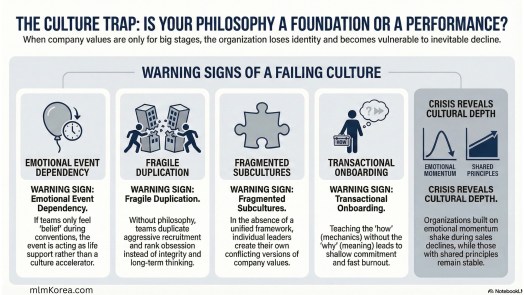
An organization can grow numerically while becoming structurally weak. And structural weakness does not show during momentum. It shows during adversity.
When Philosophy Is Absent, Leaders Create Their Own Versions
In the absence of consistent philosophical reinforcement, field leaders naturally fill the vacuum. And each leader brings personal interpretation:
- One emphasizes speed.
- Another emphasizes lifestyle.
- Another emphasizes personal branding.
- Another emphasizes product education.
Without a unifying framework, groups begin operating under slightly different values. Eventually, the company may have one compensation plan, one product line, one corporate office: but multiple subcultures.
Fragmented culture leads to confusion, internal conflict, and inconsistent messaging. New members entering the organization experience different standards depending on whose team they join. That is not sustainable growth.
Philosophy is what keeps expansion unified.
Crisis Reveals the Depth of Culture
Companies are not tested during growth seasons. They are tested during contraction.
When:
- Sales decline
- A top leader leaves
- Public criticism rises
- Regulatory changes occur
- Economic conditions tighten
Organizations built primarily on emotional momentum begin to shake. If belief was built mainly at conventions through inspiration and recognition, members may panic. But if belief was built on shared principles consistently reinforced throughout the year, stability remains.
Strong philosophy creates emotional steadiness during turbulence. Weak philosophy creates volatility.
New Members Miss the Foundation
Consider someone who joins three months after convention.
They did not experience the emotional high.
They did not hear the founding stories.
They did not feel the collective energy.
If philosophy is not embedded into onboarding and daily training, they only learn:
- How the product works
- How the compensation plan pays
- How to recruit
They learn mechanics before meaning. And when people understand “how” without deeply understanding “why,” commitment remains shallow. Shallow commitment leads to:
- Easy discouragement
- Low retention
- Fast burnout
Philosophy creates emotional attachment. It is this value-based emotional connection that sustains people — and ultimately creates longevity.
Without consistent philosophical transmission, each new generation of distributors becomes more transactional. Over time, culture thins.
Event Dependency Creates Emotional Cycles
Some organizations unintentionally train their teams to rely on events for belief restoration. You hear phrases like:
- “Just wait until convention.”
- “Everything will change after the event.”
- “You’ll get your belief back there.”
This creates a cycle:
Excitement builds toward convention.
Energy spikes at convention.
Momentum slowly declines afterward.
Another event is needed to restore belief.
This is emotional dependency.
Healthy organizations operate differently. They build:
- Daily belief
- Weekly alignment
- Monthly reinforcement
- Annual celebration
Conventions should amplify culture — not replace it.
If philosophy is operational year-round, events become accelerators.
If philosophy is absent year-round, events become life support.
Philosophy Must Be Embedded in Systems
A company’s philosophy should not only be spoken. It should be visible in structure.
Ask critical questions:
- Does onboarding reflect core values?
- Are promotions based only on production — or also on leadership behavior?
- Are recognition systems rewarding duplication quality — or just volume?
- Are leaders trained in character and mentorship — or only in recruitment techniques?
If philosophy is real, it shapes:
- Training materials
- Leadership standards
- Conflict resolution
- Compensation structures
- Communication style
When philosophy shapes systems, culture becomes self-reinforcing; when it lives only in speeches, culture becomes unstable.
Leadership Development Becomes Transactional Without Philosophy
Without consistent philosophical grounding, leadership training often becomes transactional.
Instead of developing:
- Emotional maturity
- Integrity
- Responsibility
- Mentorship skills
Organizations focus on:
- Faster ranking
- Higher bonuses
- Larger enrollments
Fast growth without philosophical depth produces fragile leadership. Fragile leadership collapses under pressure.
Strong companies understand that leadership is not a title. It is a responsibility. And responsibility must be rooted in clear values.
If conventions are the only place where values are articulated, leadership development remains shallow.
Brand Reputation Depends on Cultural Consistency
In today’s digital world, brand perception spreads quickly.
If philosophy is inconsistently understood across the field, messaging becomes inconsistent. Different leaders promote different interpretations. Social media narratives diverge. Public perception becomes fragmented.
Solution can be found in a strong philosophical foundation becuase it creates:
- Consistent messaging
- Clear identity
- Alignment between corporate and field
- Long-term credibility
Without it, the brand becomes vulnerable. Not necessarily because of external attack — but because of internal inconsistency.
Longevity Is Built on Philosophy, Not Excitement
There is a difference between companies that grow quickly and companies that last.
Fast growth can be driven by:
- Attractive compensation
- Trendy products
- Strong incentives
- Momentum cycles
Longevity is driven by:
- Shared values
- Leadership depth
- Cultural clarity
- Consistent reinforcement
Companies that endure for decades do not rely on conventions to transmit their core beliefs. Their members can articulate the company’s philosophy at any time.
Their systems reflect it.
Their leaders model it.
Their culture protects it.
Convention becomes a celebration of what already exists — not the only moment when philosophy is preached and belief is built.
The Deeper Risk
If philosophy lives only on the main stage, it becomes performance. But philosophy is not meant to be performed. It is meant to be practiced.
The greatest danger is not that people forget what was said at convention. The real danger is that they never integrate it deeply enough for it to guide behavior.
When philosophy is not integrated:
- Culture fragments
- Leadership weakens
- Growth becomes unstable
- Crisis causes overreaction
An organization may still expand, it may still produce revenue, it may still create recognition moments. But its foundation remains vulnerable. And vulnerable foundations eventually crack.
A Strong Alternative
Any company with long-term vision should treat philosophy as infrastructure.
And it should
- Teach it during onboarding.
- Reinforce it weekly.
- Align it with leadership promotion.
- Integrate it into recognition.
- Model it from the top.
The company need to understand that philosophy is a direction, not decoration. When philosophy becomes operational rather than occasional, organizations develop resilience.
They can withstand:
- Market fluctuations
- Leadership transitions
- Economic downturns
- Competitive pressure
Because their identity does not depend on events: it depends on shared conviction.
In Conclusion
A company’s future is not determined by how powerful its convention feels. It is determined by how deeply its philosophy shapes daily action.
If philosophy appears once a year, it becomes entertainment. If philosophy lives every day, it becomes legacy.
The question is simple — but critical:
Is your company’s philosophy an annual message? Or is it your operational foundation?
The answer may determine whether the organization experiences temporary momentum — or sustainable, generational success.
 Gateway to MLM Korea